Pine straw is counted in bales, not cubic yards. Divide the bed area by what one bale covers and round up. GreenPal’s worked examples, priced at a settled 2 to 3 in, and Bob Vila put a bale at roughly 35 to 50 sq ft. Counted at 3 in, a 10 × 20 ft bed needs 4 to 6 bales. GreenPal gives $3 to $5 per bale for the straw itself, which makes that bed $12 to $30. Bigger bales change the count: NC State Extension in Lee County says a 40 lb bale covers about 100 sq ft at 2 in.
How many bales of pine straw do I need?
Neither source ties its 35 to 50 sq ft to one exact depth: GreenPal prices its examples at a settled 2 to 3 in, and Bob Vila gives no depth. The calculator applies the range at 3 in, the deeper end, so it leans toward more bales, and scales it by your depth. A thinner layer stretches each bale: at 2 in the same bale covers about 52 to 75 sq ft. At 4 in it drops to about 26 to 38. For slopes and settling, GreenPal suggests adding 10 to 15%, which you can enter in the “extra %” box.
| Bed area (sq ft) | Bales at 2 in | Bales at 3 in | Straw cost at 3 in | Large bale (100 sq ft at 2 in) |
|---|---|---|---|---|
| 100 | 2 | 2–3 | $6–$15 | 1 |
| 250 | 4–5 | 5–8 | $15–$40 | 3 |
| 500 | 7–10 | 10–15 | $30–$75 | 5 |
| 1,000 | 14–20 | 20–29 | $60–$145 | 10 |
The bale counts use the 35 to 50 sq ft range; costs use GreenPal’s $3 to $5 per bale. The last column is the Lee County figure for a 40 lb bale. As a cross-check, GreenPal’s own examples put 1,000 to 1,500 sq ft of beds at 25 to 40 bales.
Bale sizes are not standard
This is the main reason bale counts disagree from one source to the next. NC State’s Managing Longleaf Pine Straw (WON-18) says no standard bale size exists. It describes bales of about 24 to 30 in long weighing roughly 8 to 25 lb dry, plus newer consumer-size bales and small round bales. Bob Vila describes a bale of about 35 lb, and the Lee County article a 40 lb one. GreenPal’s examples run from 35 sq ft for one bale to 70 sq ft for a larger one, and it notes rolls covering about 80 to 125 sq ft, or 2 to 2.5 bales each.
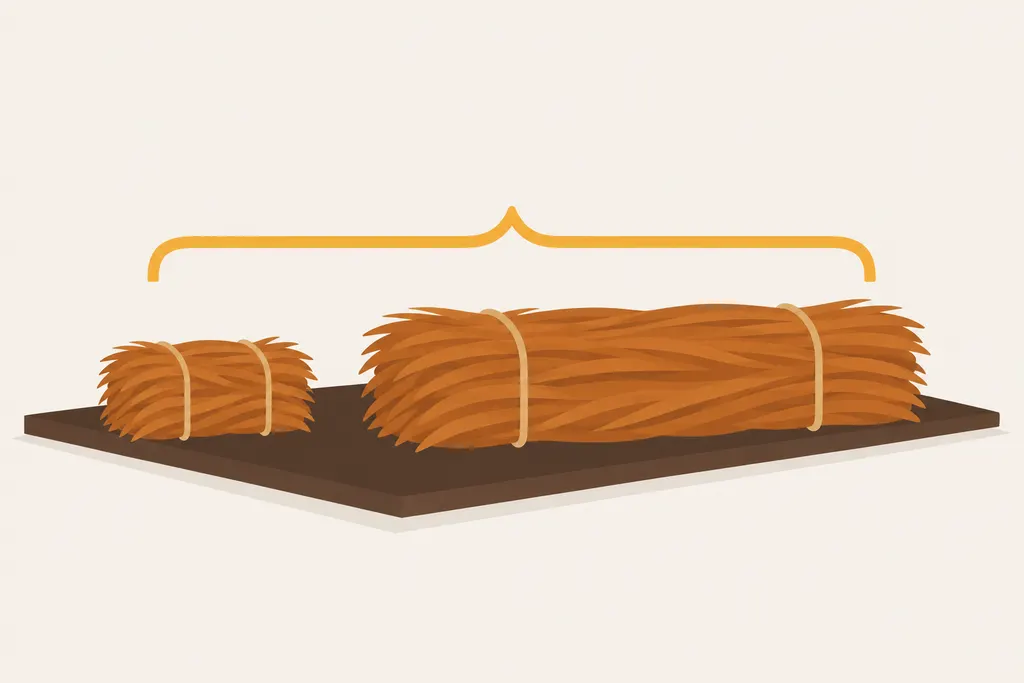
So before you buy, ask the seller what area one of their bales covers at the depth you want. Then divide your square footage by that number. If they quote 100 sq ft, a 500 sq ft bed needs 5 bales, not 10 to 15.
Needle type varies too. Bob Vila lists longleaf needles at 12 to 18 in and shorter loblolly or slash needles at 4 to 8 in.
How deep should pine straw be?
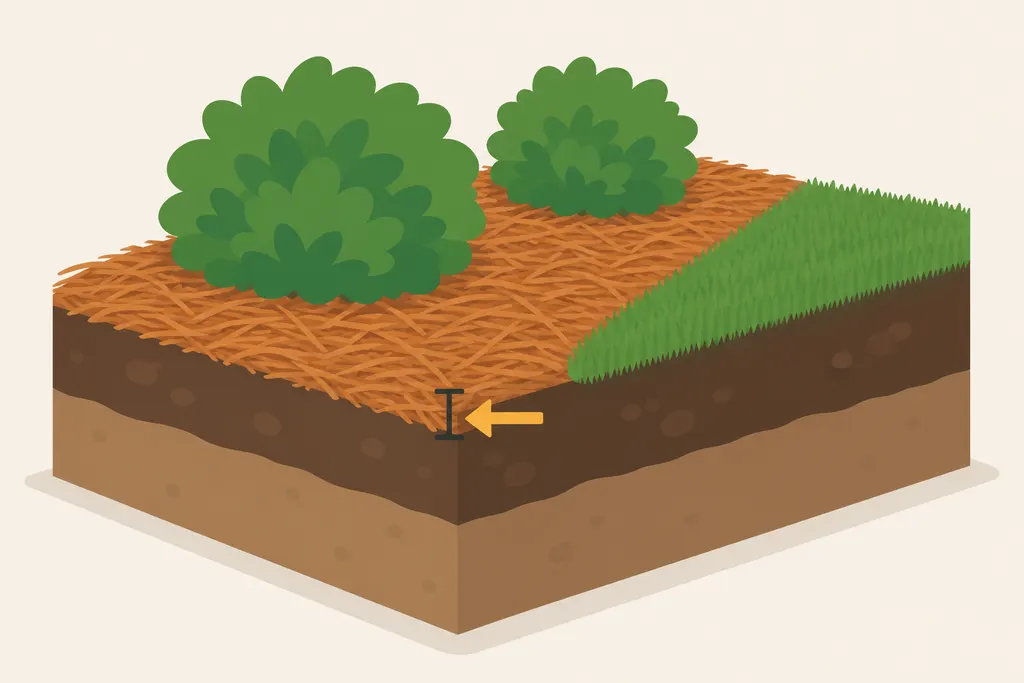
The UF/IFAS Florida-Friendly Landscaping program recommends 2 to 3 in of mulch on beds, names pine straw among the mulches it suggests, and asks for at least 2 in of clearance around tree trunks. GreenPal says a full application settles to 2 to 3 in, that bare soil may need 3 to 4 in at first, and that a refresh adds 1 to 2 in. Pine straw is fluffy when first spread, so lay it a bit thick and let it settle.
Pine straw vs wood mulch for the same bed
Here is a 10 × 20 ft bed at 3 in both ways. Switch to compare.
4 to 6 bales, about $12 to $30 in straw. Bales are light: Bob Vila puts pine straw at about 1.5 sq ft of cover per pound against about 0.5 for wood mulch. That makes it easy to carry and spread, and a car can bring home a few bales.
Bob Vila also lists the downsides. Pine straw does not smother weeds as well as other mulches, it is slippery underfoot (worse when wet or on a slope), and it can blow around in strong wind. It is also highly flammable and burns hotter than other mulch types, worth keeping in mind for beds right against the house.
50 cu ft, or about 1.85 yd. That is 25 bags of 2 cu ft, or $50 to $200 at HomeGuide’s $2 to $8 per bag. In bulk, HomeGuide’s $25 to $100 per yard comes to about $46 to $185, plus delivery of $50 to $150 per trip (Today’s Homeowner).
It is heavier: the EPA puts wood chips at 243 to 473 lb per yard, so this bed’s worth weighs about 450 to 875 lb. Open this bed in the mulch calculator or see the mulch calculator page.
Price per bale and installed price
| What you pay for | Price | Source |
|---|---|---|
| Bale, straw only | $3–$5 | GreenPal |
| Bale, average | about $4 | Bob Vila |
| Bale, installed | $6–$14 (most pay $8–$10) | GreenPal |
| Installed, per sq ft | $0.16–$0.35 | GreenPal |
| Minimum charge, jobs under about 15 bales | $80–$120 | GreenPal |
GreenPal says labor and overhead make up 55 to 65% of an installed quote, so spreading it yourself saves more than half. On a small bed the minimum charge can cost more than the straw.
How often pine straw needs topping up
GreenPal says longleaf straw holds its color for 6 to 12 months, so about once a year, while slash pine straw fades to gray in 4 to 6 months, so about twice a year. Bob Vila says pine needle mulch can last up to about a year, depending on climate and wear, and suggests leaving the old layer in place to break down under the new one. For a refresh of 1 to 2 in, set the depth to 2 in or less and the calculator will show the smaller bale count.
Run a 1,000 sq ft top-up at 2 in
Pine straw questions people ask
How many bales of pine straw do I need for 1,000 square feet?
About 20 to 29 bales at 3 in, using 35 to 50 sq ft per bale. With large bales that cover 100 sq ft at 2 in, as NC State’s Lee County office describes, it is about 10.
How much does a bale of pine straw cost?
GreenPal lists $3 to $5 per bale for the straw and $6 to $14 per bale spread by a crew. Bob Vila gives about $4 as an average bale price.
How much does a bale of pine straw weigh?
It depends on the bale. NC State’s WON-18 gives roughly 8 to 25 lb dry for longleaf bales, while Bob Vila describes a 35 lb bale and the Lee County article a 40 lb one. Heavier bales generally cover more ground.
How long does pine straw last?
About a year for longleaf straw and about six months for slash pine straw, going by GreenPal’s color estimates. Bob Vila gives up to about a year.
Is pine straw cheaper than mulch?
Per square foot, usually. For a 10 × 20 ft bed at 3 in, the straw costs about $12 to $30 against $50 to $200 for bagged wood mulch at the cited prices. Bob Vila figures pine straw stretches a dollar about 3.5 times further.
Some drawings on LandscapeFill were made with an AI image tool. They are simplified sketches of yards and materials, not photos of real projects, products, places or people.
Sources 8
Checked and updated November 22, 2026