A cubic yard is 27 cubic feet, a block 3 ft on each side. Spread 1 in thick, that block covers 324 sq ft. That single number does all the work: take the area in square feet, multiply it by the depth in inches, divide by 324, and you have cubic yards. At 2 in a yard covers 162 sq ft, at 3 in 108 sq ft, at 4 in 81 sq ft and at 6 in 54 sq ft. The volume is the same for mulch, topsoil or crushed stone. What changes from one material to the next is the weight, how the supplier prices it and how many trips it takes to bring home.
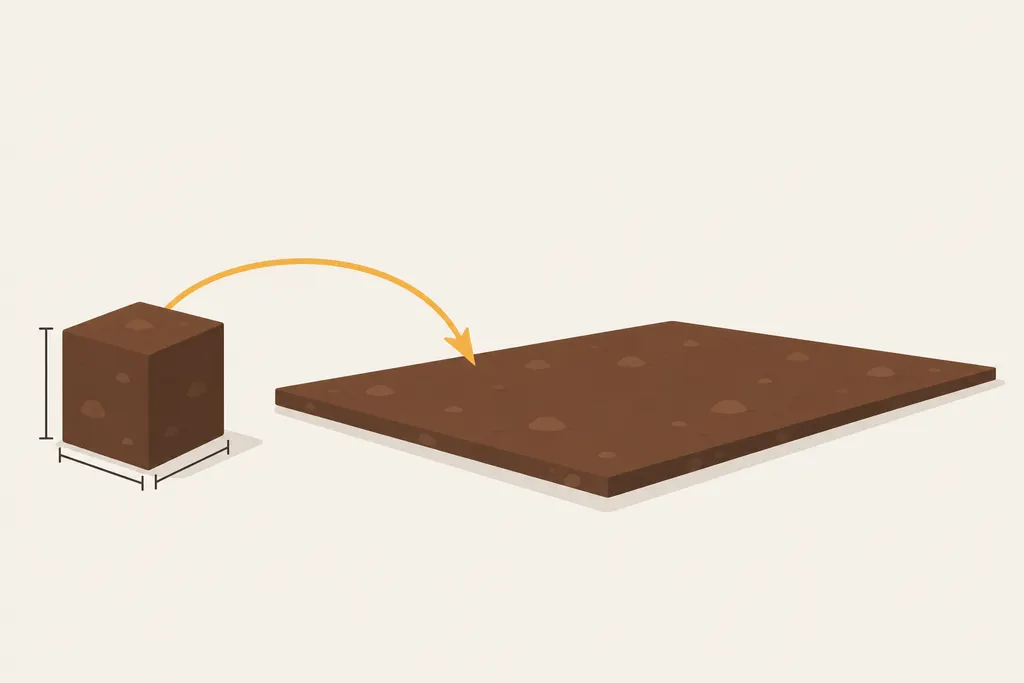
How to work out cubic yards from feet and inches
- Measure length and width in feet. Round odd inches to a decimal: 8 ft 6 in is 8.5 ft.
- Multiply them for square feet. A 10 × 12 ft bed is 120 sq ft.
- Multiply by the depth in inches: 120 × 3 = 360.
- Divide by 324: 360 ÷ 324 = 1.11 cubic yards.
If you prefer to work in feet only, turn the depth into feet first (3 in is 0.25 ft), multiply length × width × depth for cubic feet, then divide by 27. Both routes give the same answer. The calculator above takes several areas at once, so a front bed, a side strip and a tree ring can go on one order.
Cubic yards for common bed sizes
Find your area in the left column and read across to your depth. Figures are plain arithmetic (sq ft × inches ÷ 324), rounded to two places.
| Area (sq ft) | 2 in (yd) | 3 in (yd) | 4 in (yd) | 6 in (yd) |
|---|---|---|---|---|
| 50 | 0.31 | 0.46 | 0.62 | 0.93 |
| 100 | 0.62 | 0.93 | 1.23 | 1.85 |
| 200 | 1.23 | 1.85 | 2.47 | 3.70 |
| 300 | 1.85 | 2.78 | 3.70 | 5.56 |
| 500 | 3.09 | 4.63 | 6.17 | 9.26 |
| 1000 | 6.17 | 9.26 | 12.35 | 18.52 |
Bulk yards often sell in set steps, such as half or whole yards. Ask what step yours uses and round up to it.
Cubic yards vs tons: which your supplier uses
Light, bulky materials such as mulch, compost and soil are usually quoted by the yard. Stone and sand are often quoted by the ton, because a yard of rock weighs well over a ton. To turn tons into yards, divide by the tons-per-yard figure in the table; 3 tons of gravel at 1.42 tons per yard is about 2.1 yd. For what a yard or a ton of each stone costs, see the gravel price guide.
| Material | lb per cu yd | Tons per cu yd | Source |
|---|---|---|---|
| Wood chip mulch, dry to green | 243–473 | 0.12–0.24 | EPA |
| Rubber mulch | 405–675 | 0.20–0.34 | Gravel Shop (15–25 lb per cu ft) |
| Compost | 800–1,600 | 0.40–0.80 | Oregon State EM 9217 |
| Lava rock (scoria) | 950 | 0.475 | New Mexico MMD |
| Topsoil and fill dirt | 1,600–2,106 | 0.80–1.05 | New Mexico MMD; LA County DPW |
| Base course (paver base) | 2,500 | 1.25 | New Mexico MMD |
| Loose rock | 2,570 | 1.29 | LA County DPW |
| Gravel and crushed stone | 2,632–2,840 | 1.32–1.42 | LA County DPW; New Mexico MMD |
| Sand | 2,900 | 1.45 | New Mexico MMD |
These are published averages, not scale tickets. Moisture moves them a lot: Oregon State puts screened compost at about 1,000 lb per yard at 50% moisture, while very wet compost can pass 1,500 lb. Soil swings too: 2,025 lb a yard dry versus 2,106 lb wet in the LA County factors. If your supplier sells by weight, ask what factor they use for that product.
What are you ordering?
Expect a price per cubic yard. Dry mulch is light, so a truck bed often fills before payload runs out, but Today’s Homeowner says wet mulch can approach 1,000 lb a yard, and wet compost can pass 1,600 lb. UF/IFAS suggests 2–3 in of mulch on beds; compost goes on much thinner. Open the calculator for mulch, or see the mulch calculator for depth and bag prices.
Soil is sold by the yard but weighs close to a ton per yard, so weight decides how much a truck can carry. Open the calculator for topsoil, or go to the topsoil calculator for depth and cost per yard.
Ask whether the price is per yard or per ton, and use the table above to compare. Expect roughly 1.3 to 1.4 tons in every yard of gravel. Open the calculator for gravel, or read the gravel calculator.
Measuring curved and odd-shaped beds
Few beds are clean rectangles. Break the shape into pieces you can measure, then add the pieces as separate areas.
- Rectangle: length × width.
- Circle or tree ring: measure straight across, halve it for the radius, then 3.14 × radius × radius. A ring 8 ft across is about 50 sq ft.
- Half circle: half of the full circle. An 8 ft half circle is about 25 sq ft.
- Triangle or tapered corner: base × height ÷ 2.
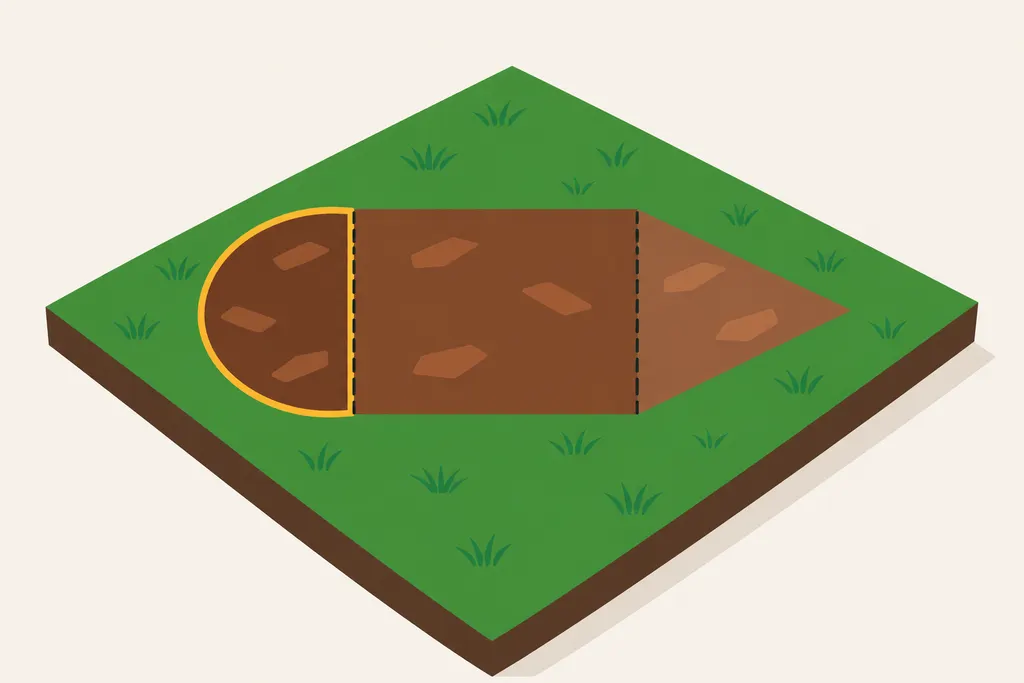
Take a kidney-shaped bed that is mostly a 12 × 4 ft strip with a rounded end 8 ft across. The strip is 48 sq ft and the rounded end about 25 sq ft, so 73 sq ft in all. At 3 in that is 0.68 cubic yards. For a bed you are topping up, push a ruler down to the soil in a few spots and use the average of what is already there, so you only order the difference.
How much a cubic yard fills: bags and pickup beds
Bags are sold by cubic feet, so divide 27 by the bag size to see how many bags equal one yard.
| Bag size (cu ft) | Bags per cu yd | Sold this way |
|---|---|---|
| 0.5 | 54 | Sand, paver base, pea and river pebbles (Quikrete) |
| 0.75 | 36 | Bagged topsoil (Hechler Hardware) |
| 0.8 | 34 | 40 lb topsoil bag (Lawn Love) |
| 1 | 27 | Bagged compost (Patuxent Nursery) |
| 2 | 13.5 | Bagged mulch (DoitBest.com) |
| 3 | 9 | Bagged mulch (Patuxent Nursery) |
For pickups, Today’s Homeowner gives a rule of thumb for a full-size truck: about 1 yard of stone, 2 of soil, or 2–3 of mulch. Read it as a bed-space rule, not a weight limit. Ford’s spec sheet gives the 6.5 ft F-150 box a volume of 62.3 cu ft, a bit over 2.3 yards, while the maximum payloads it lists run from 1,405 to 2,440 lb depending on engine and drive (Ford). One yard of gravel at 2,632–2,840 lb is over even the top figure, and two yards of soil at 1,600 lb or more each are too. Payload also has to cover the driver, passengers and gear. Enter what is left of the payload on your door-jamb label and the calculator counts trips by weight as well as bed space, using the heavy end of the published weights.
Delivery often makes more sense past a yard or two. Today’s Homeowner puts delivery at about $50–$150 per trip, with small dump trucks hauling about 5 yards and larger ones 10 or more.
Before you order
- Measure every area in feet and sketch the shapes
- Pick a depth for each area, and check what is already there
- Add the areas in the calculator and round up to the supplier’s step
- Ask if the price is per yard or per ton, and what weight factor they use
- Ask about the delivery fee, any minimum load and where the truck can dump
- Look up your truck’s payload before hauling it yourself
- Put a tarp down at the drop spot to protect the lawn or driveway
FAQ
How many square feet does a cubic yard cover?
324 sq ft at 1 in, 162 at 2 in, 108 at 3 in, 81 at 4 in and 54 at 6 in. Divide 324 by your depth in inches for any other depth.
How do I turn cubic feet into cubic yards?
Divide by 27. A load of 54 cu ft is 2 cubic yards. To go the other way, multiply yards by 27.
Is a cubic yard the same as a ton?
No. A yard is volume and a ton is weight. A yard of wood chip mulch weighs a few hundred pounds, while a yard of gravel is roughly 1.3–1.4 tons, per the LA County and New Mexico factors in the table.
How many bags make one cubic yard?
Divide 27 by the bag size: 54 bags of 0.5 cu ft, 27 of 1 cu ft, 13.5 of 2 cu ft, 9 of 3 cu ft. Round up, since you cannot buy half a bag.
How big is a cubic yard of material in a pile?
It fills a 3 × 3 × 3 ft box. Dumped on a driveway it slumps into a low mound that looks smaller than you expect, which is why people tend to under-order.
Some drawings on LandscapeFill were made with an AI image tool. They are simplified sketches of yards and materials, not photos of real projects, products, places or people.
Sources 14
Checked and updated November 25, 2026