To size a gravel order, multiply the area in square feet by the depth in inches and divide by 324. That gives cubic yards. A 4 × 20 ft path at 3 in needs 20 cu ft, or about 0.74 yd. Most yards sell gravel by the ton, so multiply cubic yards by about 1.3 to 1.4: public conversion tables put gravel at 2,632 to 2,840 lb per cubic yard. As for price, HomeGuide lists $10 to $50 per ton, $15 to $75 per yard, or $2 to $8 per bag, with the stone type making most of the difference.
How many yards of gravel do I need?
The calculator above handles several areas at once and shows yards, tons, bags and truck trips. By hand it goes like this:
- Measure the area in feet. Paths and drives are rectangles. Split curves into a half circle or a triangle.
- Choose a depth from the section below. Depth matters more than anything else in the total.
- Get cubic yards: square feet × depth in inches ÷ 324.
- Get tons: cubic yards × 1.32 to 1.42 for ordinary gravel (see the weight table).
- Add a cushion in the “extra %” box if the edges are irregular or the stone will be compacted.
The cost estimate in the tool uses crushed limestone at $30 to $54 per yard, the span between This Old House’s low figure and HomeGuide’s high one, plus one delivery trip. Pick pea gravel, river rock, landscape rock, sand or paver base in the material box for their own prices and weights.
How much is a yard or a ton of gravel?
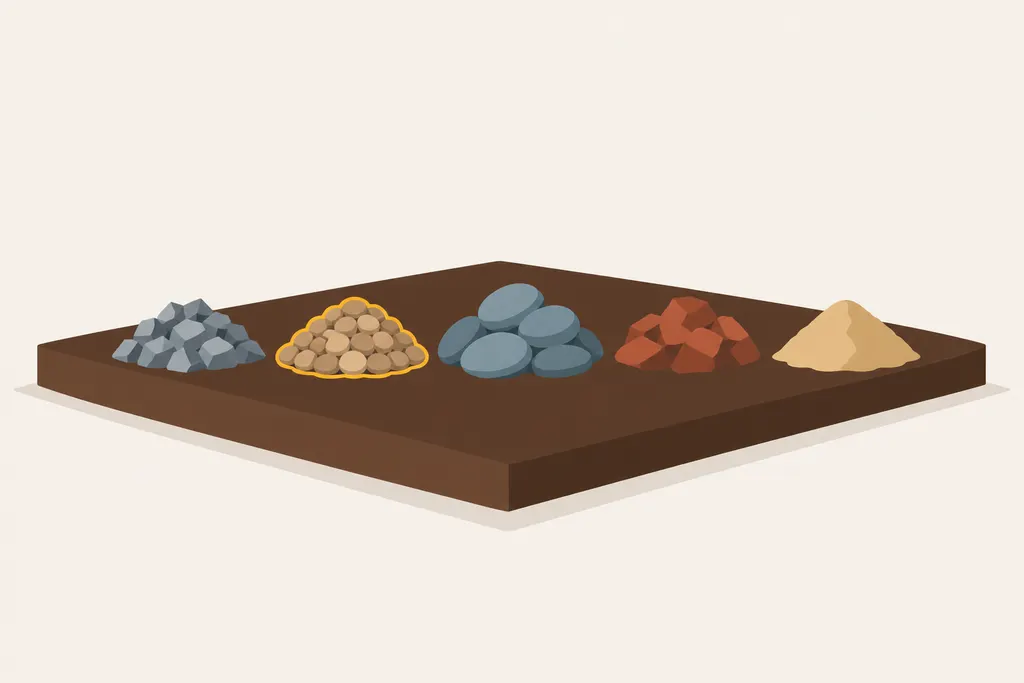
HomeGuide lists separate per-ton and per-yard ranges by type. This Old House gives per-yard ranges for four of them. The two are close for crushed limestone and river rock; pea gravel shows the widest gap.
| Type | HomeGuide per ton | HomeGuide per yard | This Old House per yard |
|---|---|---|---|
| Road base | $18–$30 | $25–$33 | – |
| Crusher run | $24–$34 | $51–$54 | – |
| Decomposed granite | $25–$50 | $38–$75 | – |
| Slate chips | $27–$64 | $35–$80 | – |
| Pea gravel | $28–$45 | $29–$86 | $20–$70 |
| Crushed limestone | $30–$38 | $35–$54 | $30–$45 |
| River rock | $33–$49 | $47–$70 | $40–$80 |
| White gravel | $52–$184 | $75–$129 | – |
| Lava rock | $76–$85 | $96–$140 | – |
| Landscape rock (mixed) | – | – | $45–$130 |
Click a column heading to sort. HomeGuide’s per-ton and per-yard columns are separate price lists, and several rows do not convert into each other. At 1.32 to 1.42 tons per yard, crusher run at $24–$34 a ton would be about $32–$48 a yard, not the $51–$54 listed. Lava rock is further off: at 0.475 tons per yard, $76–$85 a ton comes to only $36–$40 a yard against $96–$140. Pea gravel spreads wider by the yard than its ton price implies, and white gravel narrower. We show both columns as published rather than pick one. Ask your supplier which unit it quotes and what weight per yard it uses for that stone, then compare in one unit. The gravel price guide has a yards-to-tons price converter and delivered totals for 1 to 15 yards.
Bags cost far more per yard. Gravel bags commonly hold 0.5 cu ft (Quikrete sells sand, paver base, stone and pebbles in that size), so a yard is 54 bags. At HomeGuide’s $2 to $8 per bag that is $108 to $432 a yard. One nursery’s 50 lb pea gravel bag at $7.49 comes to about $404 a yard. Bags make sense for topping up a few square feet, not for a path.
How many tons are in a yard of gravel?
Weight per yard depends on the stone and how much air sits between the pieces. These are the published factors the calculator uses.
| Material | Source | Lb per cubic yard | Tons per yard | Yards per ton |
|---|---|---|---|---|
| Stone or gravel | LA County | 2,632.5 | 1.32 | 0.76 |
| Rock, loose | LA County | 2,570 | 1.29 | 0.78 |
| Gravel, 1/4–2 in | New Mexico | 2,840 | 1.42 | 0.70 |
| Sand | New Mexico | 2,900 | 1.45 | 0.69 |
| Base course | New Mexico | 2,500 | 1.25 | 0.80 |
| Scoria and cinders (lava rock) | New Mexico | 950 | 0.475 | 2.11 |
Sources: Los Angeles County Public Works and the New Mexico Mining and Minerals Division. Lava rock is the outlier: a ton of it fills more than twice the space of a ton of gravel, so never order it by weight using gravel math. Today’s Homeowner puts most gravel a little heavier, at 1.4 to 1.6 tons a yard, which shows how much the factor depends on the stone and its moisture. If you buy by the ton, ask the yard for the factor it uses.
How deep should gravel be?
Depth depends on what the gravel is for. Pick the job to see the sourced figure and open the calculator with it.
What is the gravel for?
LawnStarter describes a pea gravel walkway as about 3 in of pea gravel over a 2 in crushed rock base. Run them as two materials: 3 in of pea gravel and 2 in of crushed gravel for a 4 × 20 ft path. More on the pea gravel calculator.
The Concrete Masonry & Hardscapes Association wants a base of at least 4 in for patios and walkways, rising to 6 in for home driveways. Try a 10 × 20 ft patio base at 4 in, or see the paver base calculator.
Fixr says a gravel driveway should ideally be 12 in deep, built as three layers of about 4 in each, and that most run 8 to 12 in. The layers start with large stone at the bottom and get smaller toward the top. Run a 12 × 25 ft drive at 12 in, then price each layer separately, since base stone and top stone cost different amounts.
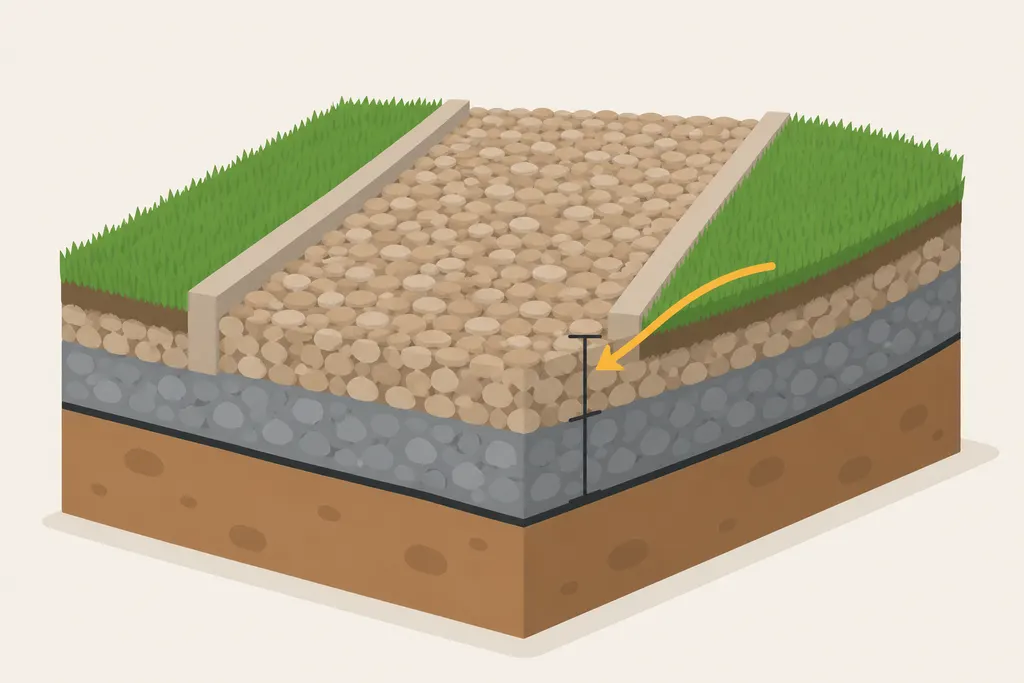
For decorative cover in a bed, none of our sources gives a set depth. The calculator starts at 3 in; change it to whatever covers the ground beneath. For smooth stone in beds and dry creeks, see the river rock calculator.
Gravel for paths and driveways: worked examples
HomeGuide prices four project sizes. Its yard figures work out to about 12 in deep for the larger three and about 8 in for the path (our arithmetic). Each button opens the calculator with the same size and that depth, so you can change the depth and see how the order shrinks.
| Project | Sq ft | HomeGuide yards | HomeGuide cost | Depth implied | Tons at 1.32–1.42 |
|---|---|---|---|---|---|
| 4 × 20 ft path | 80 | 2 | $100–$300 | 8 in | 2.6–2.8 |
| 10 × 20 ft area | 200 | 7.4 | $250–$700 | 12 in | 9.8–10.5 |
| 12 × 25 ft driveway | 300 | 11.1 | $300–$900 | 12 in | 14.7–15.8 |
| 24 × 24 ft driveway | 576 | 21.3 | $600–$1,800 | 12 in | 28.1–30.2 |
4 × 20 ft at 8 in · 10 × 20 ft at 12 in · 12 × 25 ft at 12 in · 24 × 24 ft at 12 in
A garden path rarely needs 8 in. At LawnStarter’s 3 in of pea gravel over 2 in of base, the same 4 × 20 ft path needs about 1.2 yd in total.
Hauling gravel yourself
Stone is heavy for its size. Today’s Homeowner gives a rule of thumb of about 1 cu yd of stone for a full-size pickup, yet the same article says stone and gravel can weigh upwards of 3,000 lb a yard. The conversion tables above put a yard at 2,632 to 2,840 lb. Ford’s 2026 F-150 sheet lists maximum payloads of 1,405 to 2,440 lb, depending on engine and drive, so a full yard is more than any F-150 is rated to carry. Treat the one-yard rule as a bed-space figure, not a weight limit.
Payload is everything in the truck: driver, passengers, tools and the load. Take the figure on your door-jamb label, subtract the people and gear, and divide by roughly 3,000 lb to get the most yards per trip. With 1,400 lb left over, that is less than half a yard. The calculator counts trips the same way, at the heavy end of the published weights, and by bed volume, and shows whichever needs more trips.
For anything bigger, delivery makes sense. Today’s Homeowner gives $50 to $150 per trip, about 5 yd for a small dump truck and 10 or more for a larger one.
Before you order gravel
- Measure each area in feet and run the calculator
- Choose the depth by use: walkway, paver base or driveway
- Ask whether the yard sells by the ton or the cubic yard
- Ask what weight per yard it uses for the stone you want
- For a layered driveway, price base stone and top stone separately
- Get the delivery fee and how many yards one truck carries
- Choose a dump spot the truck can reach without crossing the lawn or a septic area
- If you haul it, check your truck’s payload and split the load into trips
- Call 811 a few days before any digging
Gravel questions people ask
How much is a ton of gravel?
HomeGuide gives $10 to $50 per ton for gravel in general. By type, road base starts around $18 a ton and lava rock runs $76 to $85. Delivery is extra; Today’s Homeowner puts it at $50 to $150 per trip.
How many bags of gravel are in a yard?
Fifty-four bags of 0.5 cu ft, since a yard is 27 cu ft. That is why bagged gravel costs several times the bulk price per yard.
How much area does a ton of gravel cover?
A ton of ordinary gravel is about 0.70 to 0.76 yd, or 19 to 20.5 cu ft. Spread 2 in deep it covers roughly 114 to 123 sq ft; at 3 in, 76 to 82 sq ft; at 4 in, 57 to 62 sq ft. Fixr’s rule of thumb is a little more conservative: about 100 sq ft per ton at 2 in.
How much gravel do I need for my driveway?
At Fixr’s 12 in, a 12 × 25 ft single drive takes about 11.1 yd, or 14.7 to 15.8 tons. A 24 × 24 ft double drive takes about 21.3 yd, or 28 to 30 tons. Most of that is base stone. Topping up an existing drive takes far less; run your own size at the depth you are adding.
Is a yard of gravel more than a ton?
Yes, by weight. A cubic yard of ordinary gravel weighs about 1.3 to 1.4 tons, so a ton fills only about three quarters of a yard. Lava rock is the exception at under half a ton per yard.
Can I carry a yard of gravel in a pickup?
Not in one trip with a half-ton pickup. A yard weighs 2,632 lb or more, above every maximum payload Ford lists for the 2026 F-150 (1,405 to 2,440 lb), and your own truck’s label may show less. Split it into partial loads or have it delivered.
Some drawings on LandscapeFill were made with an AI image tool. They are simplified sketches of yards and materials, not photos of real projects, products, places or people.
Sources 11
Checked and updated November 25, 2026