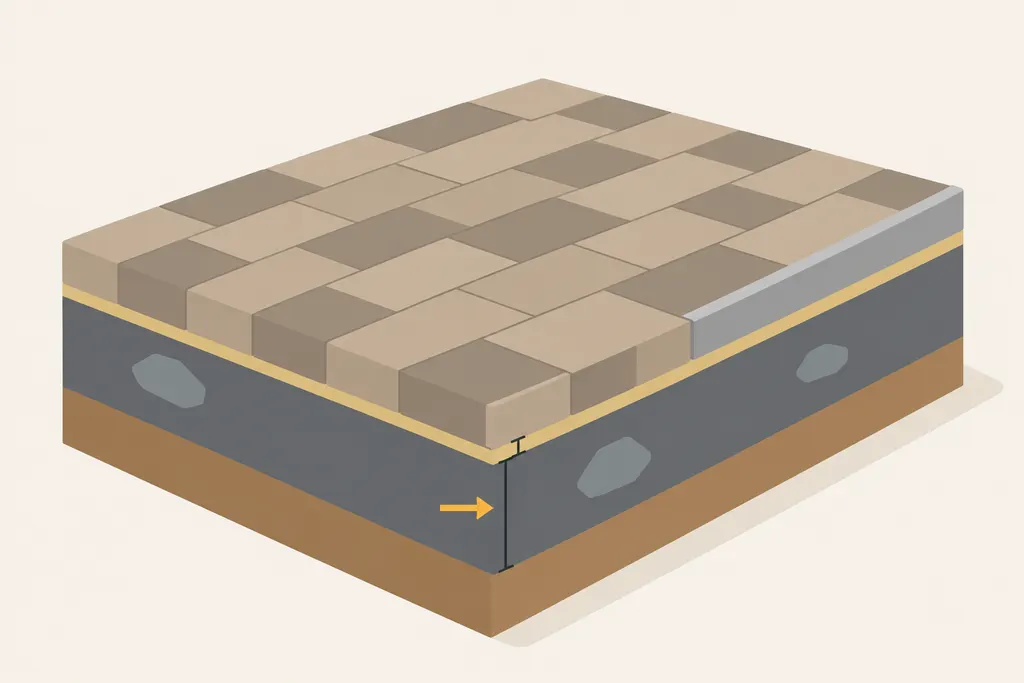
The Concrete Masonry & Hardscapes Association (CMHA) sets a 4 in minimum base for patios and walks and 6 in for home driveways. A 10 × 10 ft patio at 4 in holds 33.3 cu ft of base. That is 1.23 cubic yards, or 67 bags of 0.5 cu ft. At the 1.25 tons per yard that New Mexico EMNRD lists for base course, it weighs about 1.5 tons. A 1 in sand bed on top adds 8.3 cu ft, or 17 bags.
Run the calculator once for paver base, then switch it to sand at 1 in for the bedding layer.
How deep paver base should be for patios, walks and drives
CMHA’s minimums assume good conditions: firm soil, good drainage and no frost. For each of those three that your site lacks, CMHA suggests adding half of the minimum again. Its own driveway example with all three missing comes to 15 in. The table applies that rule.
| Use | CMHA minimum (in) | One poor condition (in) | Two poor conditions (in) | All three (in) |
|---|---|---|---|---|
| Patio or walkway | 4 | 6 | 8 | 10 |
| Home driveway | 6 | 9 | 12 | 15 |
The LSU AgCenter guide is lighter: about 3 in of gravel under a 1 in sand layer. It digs about 6 in below the finished paver surface. That is one inch less base than the CMHA minimum. For a patio that has to last, plan from the CMHA figure.
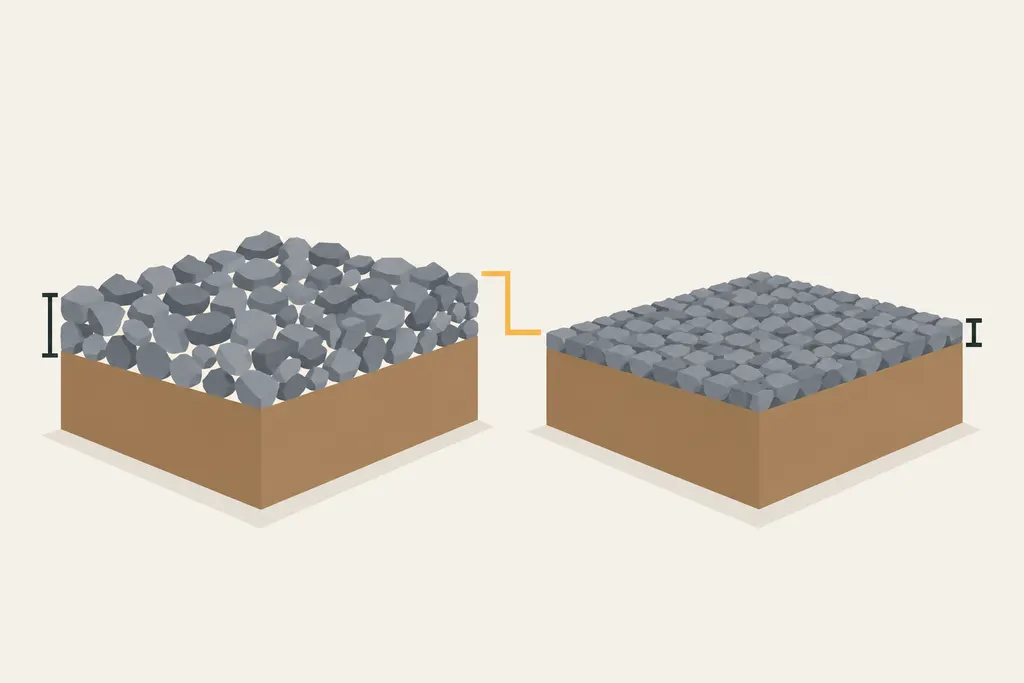
The type of base matters as much as depth. CMHA points to dense-graded aggregate made to ASTM D2940. It warns against stone dust or screenings, and against rounded rock such as river rock or pea gravel, which does not lock together.
What are you paving?
Start at CMHA’s 4 in minimum. Run a 12 × 12 ft patio at 4 in, then switch to sand at 1 in for the bedding layer.
Start at 6 in. Cars load the base far more than feet, so a driveway is worth a talk with a paving contractor. Run a 10 × 20 ft pad at 6 in.
Add half the minimum for each poor condition: 6 to 10 in for a patio, 9 to 15 in for a driveway. Run a 12 × 12 ft patio at 8 in. Near the house foundation, ask a contractor about drainage first.
Paver base plus bedding sand: two layers
The base carries the load. The sand is a thin bed the pavers settle into. LSU’s guide calls for a 1 in sand layer, screeded flat over the compacted base. Each layer is its own line on the order.
| Layer | Depth (in) | Cu ft per 100 sq ft | 0.5 cu ft bags per 100 sq ft | Tons per cubic yard |
|---|---|---|---|---|
| Paver base | 4 | 33.3 | 67 | 1.25 |
| Paver base | 6 | 50 | 100 | 1.25 |
| Bedding sand | 1 | 8.3 | 17 | 1.45 |
Weights are New Mexico’s factors for base course and sand. Bob Vila puts sand at $3–$5 per 50 lb bag, or $5–$30 per ton in bulk. LSU also grades the base to a slope of at least 2%, which is about 1 in of fall for every 4 ft. Build that slope into the base so the sand layer stays an even thickness.
Run 1 in of sand for a 10 × 10 ft patio
Compacting: loose depth is not finished depth
CMHA’s depths describe the finished base. Base spread loose from a pile is thicker and softer, and it packs down under a plate compactor. CMHA counts compaction as part of a stable base and calls a plate compactor of less than 5,000 lb of force too small, which is worth knowing at the rental counter. LSU has the base moistened lightly, compacted, re-graded and compacted again until smooth.
We did not find a published figure for how much paver base shrinks when compacted. It depends on the product and its moisture. The calculator gives the finished volume. Ask your supplier how much extra to order, then type that in the extra percent box.
Bags vs bulk base for a small patio
Bagged paver base comes in 0.5 cu ft bags (Quikrete). One retailer lists it at $5.99 a bag (Elitsac). That is a single store’s price, not a range. We found no sourced bulk price for material sold as “paver base.” HomeGuide does price road base and crusher run, two bulk bases yards often offer. Those are shown here as comparable materials, not as paver base.
The 10 × 10 ft patio at 4 in needs 67 bags. At $5.99 a bag, that is about $401 before sand. Bags make sense for a small landing or for topping up a low spot. Lifting 67 bags is real work, so plan the trips.
The same patio is 1.23 cubic yards, about 1.5 tons. HomeGuide prices are below.
| Comparable base | Per ton | Per cubic yard | For 1.23 yd |
|---|---|---|---|
| Road base | $18–$30 | $25–$33 | $31–$41 |
| Crusher run | $24–$34 | $51–$54 | $63–$67 |
Delivery adds $50–$150 per trip (Today’s Homeowner). Ask whether the yard’s base meets ASTM D2940, the grade CMHA points to. At 1.25 tons a yard, 1.23 yards weigh about 3,090 lb, and damp crushed stone can run heavier. That is more than the 2,440 lb top payload Ford lists for any 2026 F-150 (Ford). Size each pickup load to the payload on your door-jamb label, less the people and gear aboard, which means at least two trips and often three; a delivery is often simpler.
How many pavers you need (by paver size)
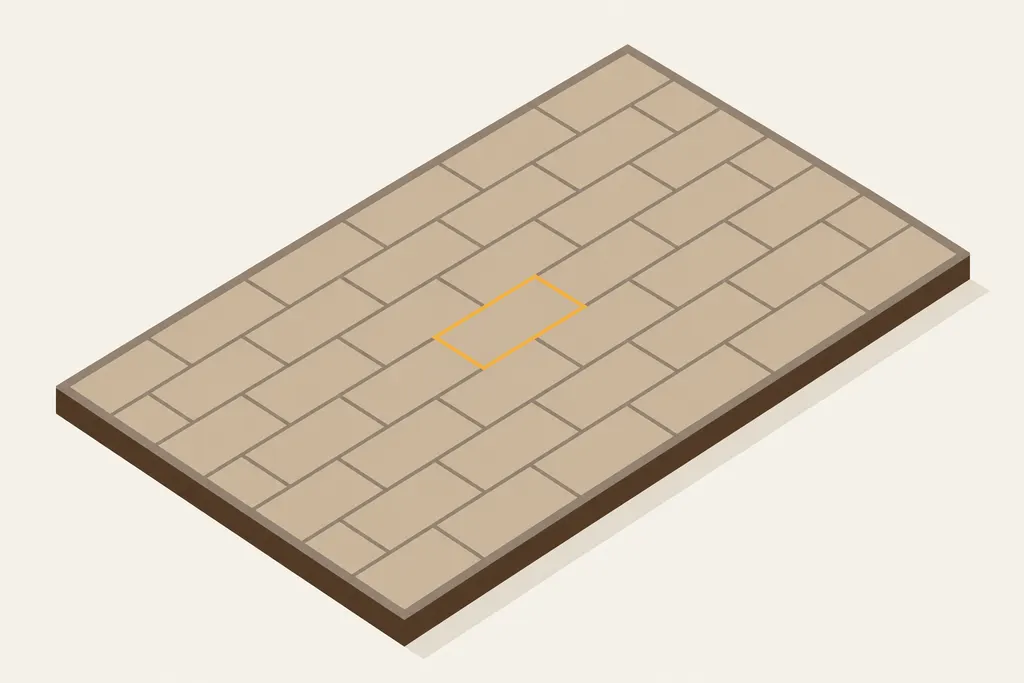
A square foot is 144 sq in. Divide 144 by the paver’s face area (length times width, in inches) to get pavers per square foot. Then multiply by the patio area. The table uses nominal sizes. Check the real size on the label, since actual pavers and joints can differ a little.
| Paver face (in) | Face area (sq in) | Pavers per sq ft | Pavers per 100 sq ft |
|---|---|---|---|
| 4 × 8 | 32 | 4.5 | 450 |
| 6 × 6 | 36 | 4.0 | 400 |
| 4 × 12 | 48 | 3.0 | 300 |
| 6 × 9 | 54 | 2.67 | 267 |
| 8 × 8 | 64 | 2.25 | 225 |
| 6 × 12 | 72 | 2.0 | 200 |
| 12 × 12 | 144 | 1.0 | 100 |
| 16 × 16 | 256 | 0.56 | 57 |
| 12 × 24 | 288 | 0.5 | 50 |
| 24 × 24 | 576 | 0.25 | 25 |
Cuts at the edges and around corners waste some pavers. Patterns with many angled cuts waste more than a straight grid. How much extra to buy is your choice. As an example, a 10 × 10 ft patio in 6 × 9 in pavers needs 267. With a 10% allowance you would buy 294.
Questions to ask your supplier
- Is this base a dense-graded aggregate to ASTM D2940?
- Is it priced per ton or per cubic yard, and what does a yard weigh?
- How much extra should I order to allow for compaction?
- What is the delivery charge, and is there a minimum load?
- Is the bedding sand sold in bags, bulk or both?
- What are the actual paver dimensions, and how many come on a pallet?
- Has 811 been called before the patio area is dug out?
Questions people ask
How many bags of paver base do I need?
One 0.5 cu ft bag covers 1.5 sq ft at 4 in deep, or 1 sq ft at 6 in. A 10 × 10 ft patio at 4 in needs 67 bags. A 12 × 12 ft patio needs 48 cu ft, which is 96 bags.
How thick should the sand be under pavers?
LSU AgCenter’s guide uses a 1 in layer of sand between the compacted base and the pavers. For 100 sq ft that is 8.3 cu ft, or 17 bags of 0.5 cu ft.
Can I use pea gravel or river rock as paver base?
CMHA advises against it. Rounded stone rolls and does not lock into a firm layer. It also warns against stone dust and screenings. Its guidance points to dense-graded aggregate made to ASTM D2940.
How many pavers per square foot?
Divide 144 by the paver’s length times width in inches. A 6 × 9 in paver gives 2.67 per sq ft, a 4 × 8 in paver 4.5, and a 12 × 12 in paver exactly 1.
Does paver base need to be deeper in cold climates?
CMHA counts frost as one of three site conditions, along with weak soil and poor drainage. For each one present, it suggests adding half the minimum base depth. A patio with frost but good soil and drainage goes from 4 in to 6 in.
Some drawings on LandscapeFill were made with an AI image tool. They are simplified sketches of yards and materials, not photos of real projects, products, places or people.
Sources 9
Checked and updated November 22, 2026