The calculator counts blocks course by course. Blocks per course are the wall length divided by the block’s face length, rounded up. Courses are the height divided by the face height, plus the courses that sit below ground. Take a 20 ft wall standing 2 ft tall in 6 × 16 in blocks. That is 15 blocks per course and 4 exposed courses plus 1 buried, so 75 blocks and 15 caps. Under it goes a 24 in wide trench with 6 in of base gravel, about 0.74 cubic yards. Behind it goes a 12 in band of drain rock, about 1.85 yards. Those base and drain figures follow the Allan Block residential guide. At $2–$10 per block (LawnStarter), the blocks alone run $150 to $750.
This page covers estimating. It does not cover how to build a tall wall. That part belongs to the block maker’s guide, and above about 4 ft, to an engineer.
How many blocks per square foot of wall face
A square foot is 144 sq in. Divide 144 by the block’s face (height times length, in inches) to get blocks per square foot. Face sizes come from each maker’s sheet. The calculator offers these four sizes:
| Block (face size) | Face area (sq in) | Blocks per sq ft | Blocks per 100 sq ft | Courses per ft of height | Weight (lb) | Spec source |
|---|---|---|---|---|---|---|
| Small, 4 × 11.5 in | 46 | 3.13 | 314 | 3 | — | Lowe’s install sheet |
| Lite Stone type, 4 × 18 in | 72 | 2.0 | 200 | 3 | — | Allan Block guide |
| Standard, 6 × 16 in | 96 | 1.5 | 150 | 2 | 82 | VERSA-LOK cut sheet |
| Large, 8 × 18 in | 144 | 1.0 | 100 | 1.5 | 75 | Allan Block AB Collection |
The spec sheets agree with the arithmetic. The VERSA-LOK sheet lists 0.667 sq ft of face per block, and Allan Block lists about 1 sq ft for its 8 × 18 in Classic.
Face area alone undercounts a little. The calculator rounds each course up to whole blocks and adds the buried rows. Those buried rows are not part of the visible wall face.
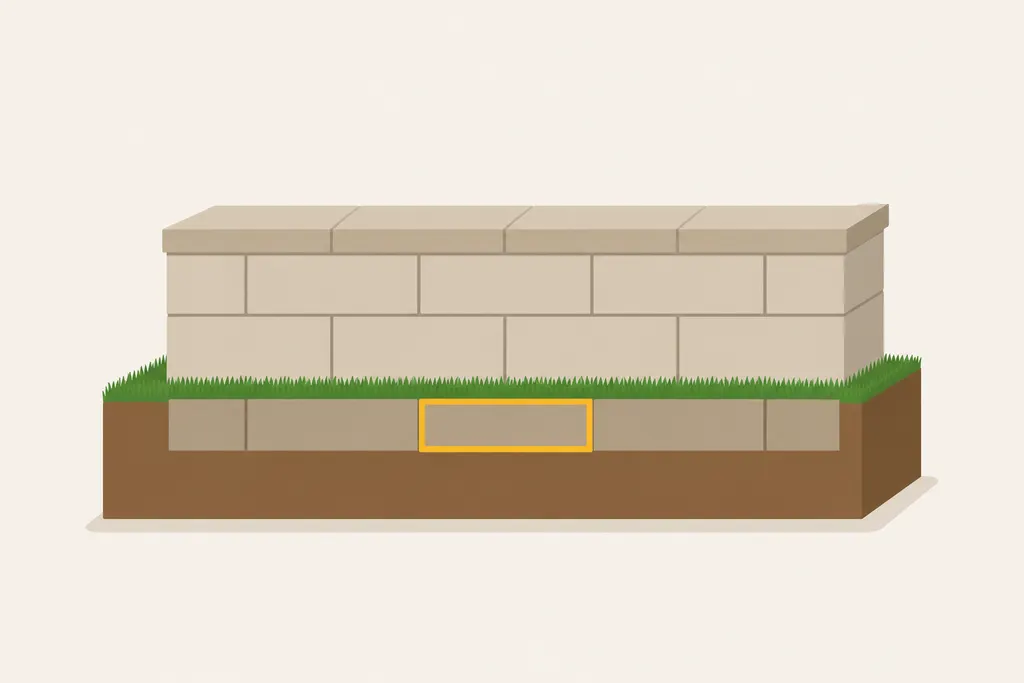
Caps, base course and gravel backfill
Caps. The calculator assumes one cap per block on the top course. Caps come in their own sizes. Allan Block’s AB Capstone is 18 in long, so a 20 ft wall takes 14 of them. Use the cap’s own length if it differs from the block.
Buried course. The Allan Block guide buries 1 in of block for every foot of wall height. A 2 ft wall needs only 2 in below grade. Since a course can’t be partly buried, the calculator puts at least one full course underground. That course costs the same as any other, so count it.
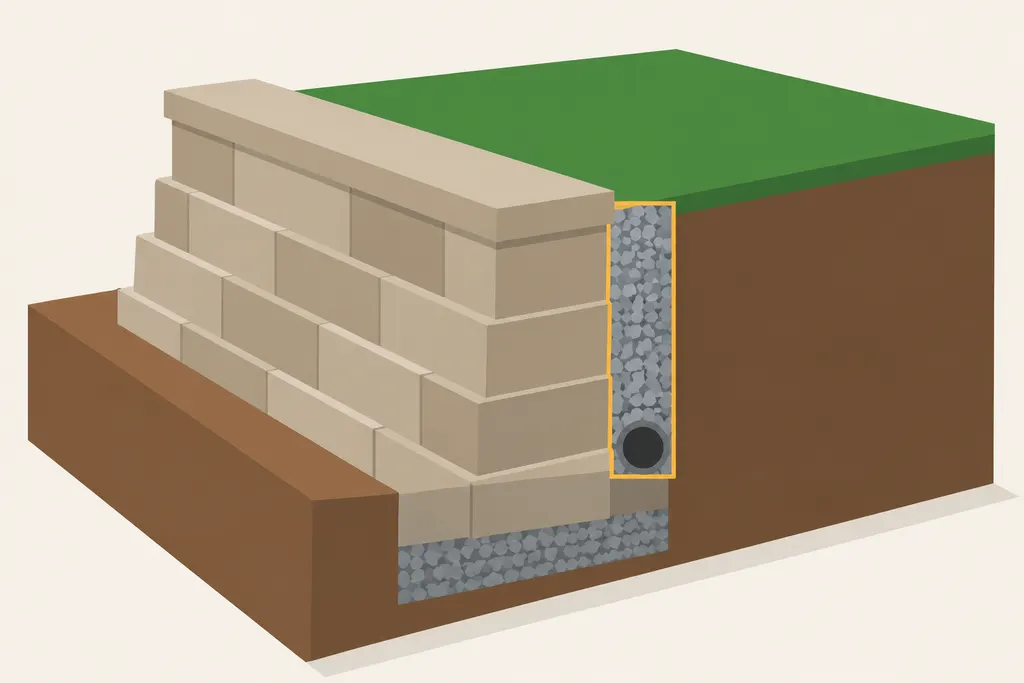
Base. The same guide’s standard base is a trench 24 in wide with 6 in of compacted wall rock. That works out to 0.37 cubic yards per 10 ft of wall. For walls under 4 ft, the guide allows a smaller trench, 18 in wide and 4 in deep plus the buried block. The calculator keeps the larger standard, so for a short wall it may count more base gravel than you need. The Lowe’s sheet for a small 4 × 11.5 in block is lighter: a trench 12 in wide and 4 in deep, plus a 4 in leveling pad in organic soil. Use the guide for the block you buy.
Drain rock. Allan Block keeps at least 12 in of wall rock behind the block for the full height, buried rows included. For a wall 2.5 ft tall in total, that is 0.93 yards per 10 ft. New Mexico lists gravel at 1.42 tons per yard (EMNRD), so the 20 ft example needs about 1 ton of base and 2.6 tons of drain rock.
Price 6 in of base gravel for a 20 ft trench
Retaining wall cost per square foot
Cost guides price walls by square foot of face: length times visible height. The 20 × 2 ft example is 40 sq ft.
| Wall type or item | Price | Unit | Source |
|---|---|---|---|
| Any retaining wall, installed | $20–$53 (average $33) | sq ft | LawnStarter |
| Interlocking block, installed | $15–$35 | sq ft | LawnStarter |
| Segmental block, installed | $15–$35 | sq ft | Fixr |
| Natural stone, installed | $25–$75 | sq ft | Fixr |
| Timber, installed | $15–$30 | sq ft | Fixr |
| Poured concrete, installed | $30–$40 | sq ft | Fixr |
| Do-it-yourself, all materials | $4–$20 | sq ft | LawnStarter |
| Wall blocks | $2–$10 | each | LawnStarter |
| Permit fee | $40–$450 | permit | LawnStarter |
For the 40 sq ft example, block walls installed run $600 to $1,400 at $15–$35, or up to $2,120 at LawnStarter’s $53 top. Done yourself, the same wall is $160 to $800 in materials. A 50 ft wall 3 ft tall is 150 sq ft, which comes to $2,250 to $5,250 installed in block.
When a wall needs an engineer or a permit
The International Residential Code exempts many short walls from permits. The City of Port Townsend handout is one city’s summary of that rule. Walls 4 ft or less, measured from the bottom of the footing to the top, are exempt if nothing extra presses on the soil behind them. That extra load is called a surcharge: a driveway, a slope or a building. A surcharged wall needs engineering at any height. LawnStarter puts the usual permit line at 4 ft. Fixr says walls over 3 to 4 ft typically need a permit and calls for a structural engineer above 4 ft. Your city or county may set it differently, so ask the building department.
Note where that 4 ft is measured from. Buried courses and the base count toward it. With 8 in blocks, a 3.5 ft wall rounds up to 6 visible courses plus 1 buried. That is 4 ft 8 in of block before the base. The calculator warns when the block stack passes 4 ft.
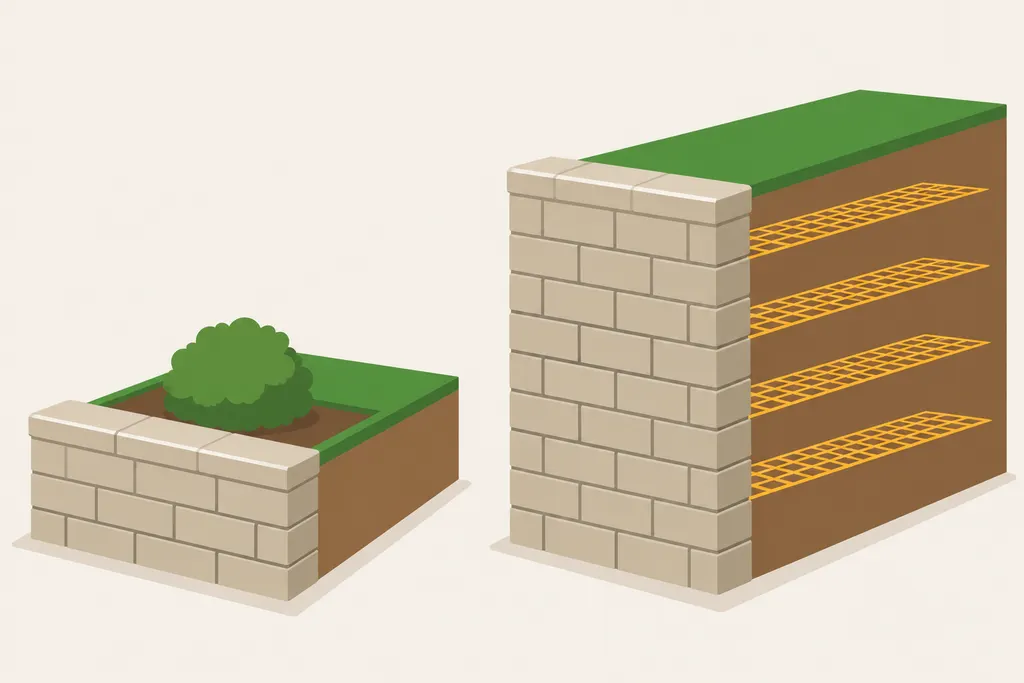
The block maker sets its own limit too. The Allan Block guide gives unreinforced height limits for 6° blocks such as its Classic from about 3 ft 2 in in clay to 4 ft 7 in in silty sand, with level ground above. A slope or load above the wall lowers those limits. Above that, the wall needs reinforcement designed for the site.
What kind of wall is it?
Short walls on flat ground are the simplest case. Still check your block’s own height limit and your local permit rules, then run a 30 ft × 2 ft wall.
You are near both the 4 ft permit line and the block maker’s unreinforced limits. Count buried courses and the base in the height. Ask the building department before buying block.
Plan on a licensed engineer’s design, and usually a permit. Use the calculator only as a rough material count. The engineer may change the block, the base and the reinforcement.
Drainage behind the wall
Water trapped behind a wall adds pressure that the blocks were not sized for. Allan Block’s guide keeps at least 12 in of wall rock behind the block. The calculator sizes that band from the full block height. Pipe and fabric are not counted here. Their layout comes from the block maker’s guide or your designer.
Questions to ask a contractor before signing:
- Which block will you use, and which install guide do you follow?
- How wide and deep is the base, and how much gravel is in the price?
- Is drain rock behind the wall included, and how deep is the band?
- Does the price per square foot include caps and the buried course?
- Does the wall need a permit here, and who applies for it?
- Is there a slope, driveway or building above the wall that calls for an engineer?
- Will 811 be called before the trench is dug?
Questions people ask
How many blocks do I need for a 50 ft retaining wall?
At 2 ft tall in 6 × 16 in block, a 50 ft wall takes 38 blocks per course over 5 courses, one of them buried. That is 190 blocks and 38 caps. In 8 × 18 in block it takes 34 per course over 4 courses, so 136 blocks.
How much does a 100 ft retaining wall cost?
At 3 ft tall, the face is 300 sq ft. Block walls at $15–$35 per sq ft installed come to $4,500 to $10,500. LawnStarter’s range for all wall types, $20–$53, gives $6,000 to $15,900.
How tall can a retaining wall be without a permit?
Under the IRC rule summarized by Port Townsend, 4 ft from the bottom of the footing to the top, with no surcharge behind it. Local rules can differ, and a wall holding back a slope or driveway needs engineering at any height.
How much gravel goes behind a retaining wall?
Allan Block’s guide uses at least 12 in of wall rock behind the block for its full height. For 10 ft of wall with 2.5 ft of total block height, that is 25 cu ft, or 0.93 cubic yards.
Do I count the buried course when ordering blocks?
Yes. The Allan Block guide buries 1 in of block per foot of height, and the calculator rounds that up to at least one full course. Those blocks are on the order even though nobody will see them.
Some drawings on LandscapeFill were made with an AI image tool. They are simplified sketches of yards and materials, not photos of real projects, products, places or people.
Sources 8
Checked and updated November 22, 2026