Mulch is sold by volume, so the math is short: bed area in square feet times depth in inches, divided by 324, gives cubic yards. A 10 × 4 ft bed at 3 in comes to 10 cu ft, which is 0.37 yd or five 2 cu ft bags. The UF/IFAS Florida-Friendly Landscaping program suggests 2 to 3 in on planting beds, so most orders land between 108 and 162 sq ft of bed per cubic yard. Price swings more than volume does: bagged mulch ran about $27 to $108 per yard-equivalent in the figures we found, and bulk $25 to $100 per yard before delivery.
How much mulch do I need?
Work bed by bed, then add the pieces together. The calculator above does this for you, but here is what it does:
- Measure each bed in feet. Rectangles are length × width. Round beds and tree rings use the distance across. Odd shapes can be split into a rectangle plus a half circle or a triangle; add as many areas as you need.
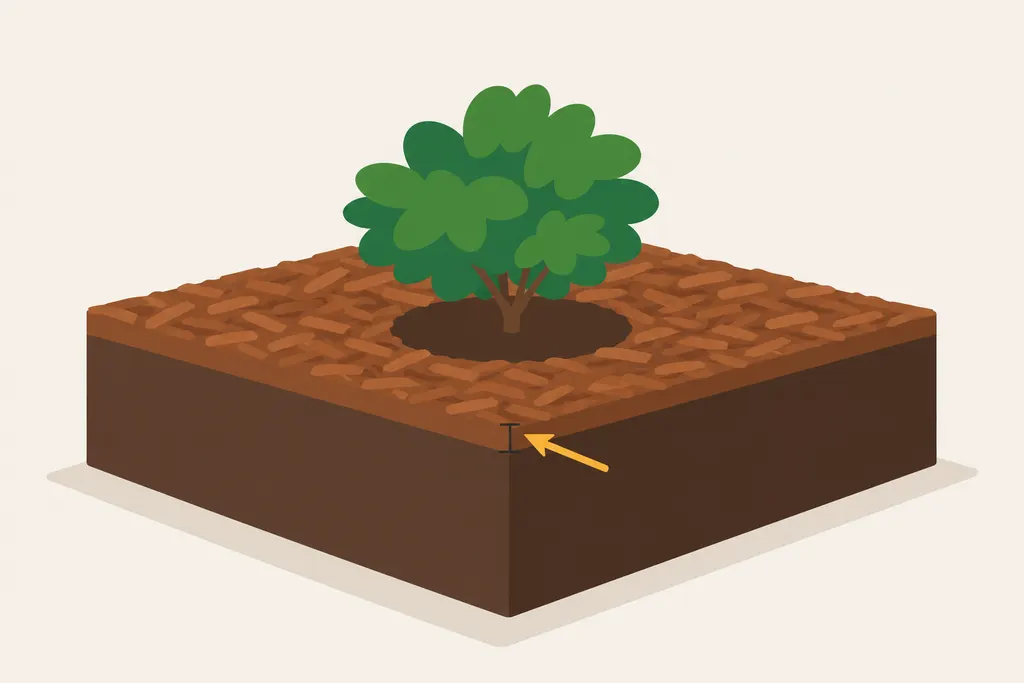
- Pick a depth in inches. For beds, 2 to 3 in (UF/IFAS). If old mulch is still there, poke a ruler into it and order only the difference.
- Convert. Square feet × inches ÷ 12 = cubic feet. Cubic feet ÷ 27 = cubic yards. Or in one step: square feet × inches ÷ 324.
- Turn it into bags or a bulk order. Divide cubic feet by the bag size and round up.
Curved edges and settling make most people a little short, so the calculator has an “extra %” box if you want a cushion.
How much does a yard of mulch cover?
One cubic yard spread 1 in deep covers 324 sq ft (27 cu ft × 12). For any other depth, divide 324 by the inches. The bag columns use the same arithmetic for the two common bag sizes. These are flat-ground figures with no allowance for settling. The same yard math works for soil and stone on the cubic yard calculator.
| Depth | 1 cubic yard covers (sq ft) | One 2 cu ft bag (sq ft) | One 3 cu ft bag (sq ft) |
|---|---|---|---|
| 1 in | 324 | 24 | 36 |
| 2 in | 162 | 12 | 18 |
| 3 in | 108 | 8 | 12 |
| 4 in | 81 | 6 | 9 |
How many bags of mulch in a yard?
A yard holds 27 cu ft. That is 13.5 bags of 2 cu ft (you buy 14) or 9 bags of 3 cu ft. Both sizes are on store shelves: DoitBest.com lists 2 cu ft shredded hardwood, and Patuxent Nursery sells 3 cu ft bags. The size is printed on the bag, so check it before you count.
| Cubic yards | 2 cu ft bags | 3 cu ft bags |
|---|---|---|
| 0.5 | 7 | 5 |
| 1 | 14 | 9 |
| 2 | 27 | 18 |
| 3 | 41 | 27 |
| 5 | 68 | 45 |
A bag’s weight depends on how wet the wood is. The EPA’s conversion factors put wood chips at 243 lb per cubic yard dry and 473 lb green, which works out to roughly 18 to 35 lb for a 2 cu ft bag.
How deep should mulch be?
UF/IFAS gives 2 to 3 in for beds and asks home gardeners to leave at least 2 in of bare ground around tree trunks so the bark does not stay wet and rot. Its advice for landscape professionals goes further: pull mulch back 1 to 2 in from plant bases and keep anything over a tree’s root ball to a thin layer of 1 in or less.
Depth is also the biggest lever on cost. Going from 2 in to 3 in adds half again to the order, and 4 in doubles the 2 in amount. If the bed already has an inch of old mulch, a 3 in target means buying only 2 in.
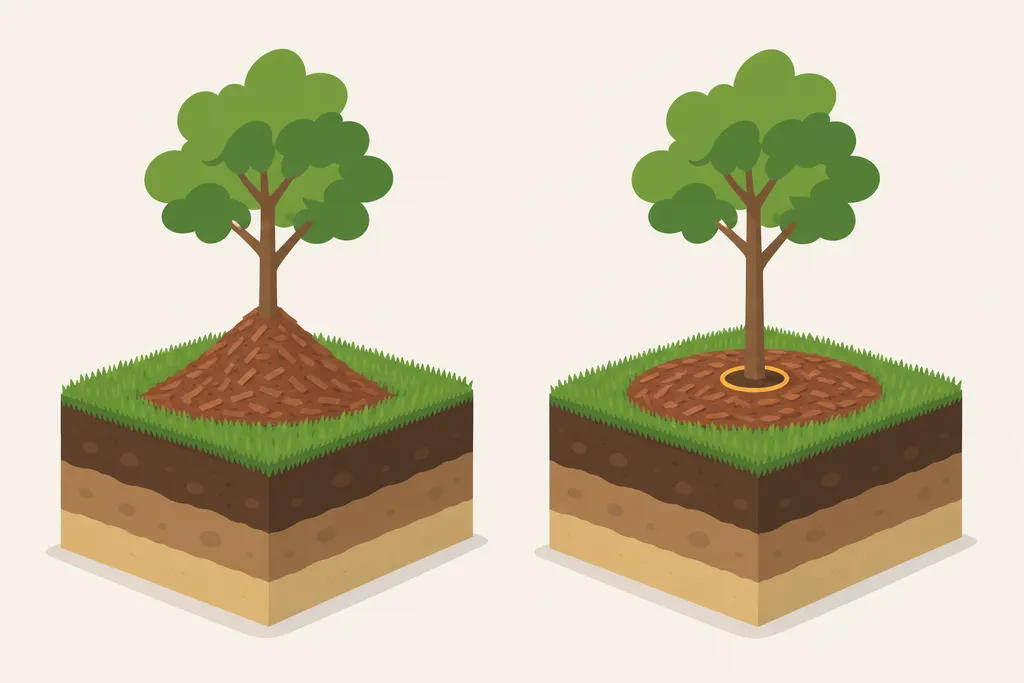
The ring on the right is the shape to aim for: flat, even, and stopping short of the trunk. A cone heaped against the bark uses more mulch and does the tree no favors.
What is the 3-3-3 rule for mulch?
The 3-3-3 rule is a memory aid for mulching around a tree. It comes from gardening articles, not from a university handout. LawnStarter’s version reads: a layer 3 in deep, a ring reaching about 3 ft out from the trunk, and a 3 in bare gap between the mulch and the bark. Extension services give numbers in the same neighborhood, but each draws the lines a little differently:
| Part of the rule | 3-3-3 (LawnStarter) | Mississippi State Extension | University of Maryland Extension | UF/IFAS |
|---|---|---|---|---|
| Depth | 3 in | 3–4 in | 1–3 in | 2–3 in on beds |
| Gap at the trunk | 3 in | 2–3 in | about 3 in | at least 2 in |
| How far out | 3 ft from the trunk | 3–6 ft from the trunk | out to the branch tips, where possible | – |
So the definitions differ. Mississippi State wants a deeper and wider ring, while Maryland keeps the layer shallow and would carry it as far as the canopy reaches. All four agree on one point: mulch should never touch the trunk.
In numbers, a ring 3 ft out from the trunk is 6 ft across and about 28 sq ft. At 3 in that is roughly 7 cu ft: four 2 cu ft bags or three 3 cu ft bags. The 3 in gap at the center is too small to change the count. Stretch the ring to Mississippi State’s 6 ft and it becomes 12 ft across, four times the area and a little over a cubic yard. If old mulch is already there, measure it and buy only enough to bring it back to 3 in.
Mulch price per yard: bags vs bulk
Published prices vary widely, and the sources do not agree. Here is what each one says, converted to a per-yard figure so the rows compare.
| How you buy | Source | Price as published | Per cubic yard (our arithmetic) |
|---|---|---|---|
| 2 cu ft bag | HomeGuide | $2–$8 per bag | $27–$108 |
| 2 cu ft bag | LawnStarter | $3.25–$6.50 per bag | $44–$88 |
| 3 cu ft bag | Patuxent Nursery (one store) | $5.49–$7.49 per bag | $49–$67 |
| Bulk | HomeGuide | $25–$100 per yd | $25–$100 |
| Bulk, materials only | Fixr | $40–$60 per yd | $40–$60 |
| Installed | HomeGuide | $50–$150 per yd | $50–$150 |
| Delivery | Today’s Homeowner | $50–$150 per trip | – |
HomeGuide gives the widest ranges. LawnStarter and Fixr sit inside them. The calculator uses the widest range on purpose: $2 to $8 per 2 cu ft bag and $25 to $100 per bulk yard, plus $50 to $150 for one delivery trip from Today’s Homeowner. That makes the result honest but broad. When the bag and bulk ranges overlap, the tool says so instead of picking a winner; a local price list will settle it.
Bags suit small jobs and tight access. There is no delivery fee, you can carry them through a side gate, and leftovers keep for later. A 10 × 4 ft bed at 3 in needs five 2 cu ft bags, about $10 to $40 at HomeGuide’s bag prices.
The catch is the per-yard price. Thirteen and a half bags at LawnStarter’s $3.25 to $6.50 come to $44 to $88 for one yard’s worth, and you lift every bag yourself. Mixing sizes is fine; enter 3 in the bag box of the calculator to count 3 cu ft bags instead.
Bulk suits big jobs. It is sold by the cubic yard and usually dumped on your driveway. The delivery fee is the part that decides it. Using midpoints of the cited ranges (LawnStarter bags at $4.88, Fixr bulk at $50 a yard), bags cost about $16 more per yard. A $50 delivery fee pays for itself at about 3 yd, a $100 fee at about 6 yd, and a $150 fee at about 9.5 yd.
Hauling it yourself? Today’s Homeowner says a full-size pickup carries 2 to 3 yd of mulch. Ford’s 2026 F-150 spec sheet lists a 6.5 ft box at 62.3 cu ft, about 2.3 yd level full, and maximum payloads from 1,405 to 2,440 lb. Three yards of green wood chips at the EPA’s 473 lb per yard weigh about 1,420 lb, already past the low end of that range. Today’s Homeowner adds that wet mulch can weigh up to about 1,000 lb a yard, so a heaped bed of soaked mulch can outweigh the payload. The calculator counts trips at that heavier figure.
Before you order mulch
- Measure every bed in feet, including tree rings and curved corners
- Decide on a depth (2 to 3 in for beds) and check how much old mulch is left
- Run the calculator and note the cubic yards and the bag count
- Price both ways: bag count × local bag price, and yards × bulk price + delivery
- Ask the supplier for its minimum bulk order and delivery fee
- Pick a dump spot close to the beds and lay a tarp if it is on the lawn
- If you haul it, check the payload on your truck’s door sticker
- Plan to keep mulch 2 in back from tree trunks
Mulch questions people ask
How many bags of mulch do I need for 100 square feet?
At 3 in deep, 100 sq ft takes 25 cu ft: 13 bags of 2 cu ft or 9 bags of 3 cu ft. At 2 in it takes about 16.7 cu ft: 9 bags of 2 cu ft or 6 bags of 3 cu ft.
How much does a yard of mulch weigh?
The EPA uses 243 lb per cubic yard for dry wood chips and 473 lb for green ones. Fresh, wet mulch sits at the heavy end; mulch that has dried in a bin weighs less.
Will a yard of mulch fit in a pickup?
Usually yes. Today’s Homeowner puts a full-size pickup at 2 to 3 yd of mulch, and the F-150’s 6.5 ft box holds 62.3 cu ft, more than the 27 cu ft in one yard. One yard weighs 243 to 473 lb by the EPA’s factors, or up to about 1,000 lb when soaked (Today’s Homeowner). For more than a yard of wet mulch, check the load against the payload on your door-jamb label.
How much mulch goes around a tree?
A ring 8 ft across covers about 50 sq ft. At 3 in that is about 12.6 cu ft, or seven 2 cu ft bags. Keep it flat and hold it 2 in back from the trunk, as UF/IFAS advises. Run the tree ring.
What is the 3-3-3 rule for mulch?
A shorthand for tree rings: mulch 3 in deep, spread about 3 ft out from the trunk, with a 3 in gap left at the bark (LawnStarter). Extension advice differs at the edges: Mississippi State says 3 to 4 in deep and 3 to 6 ft out, Maryland says 1 to 3 in deep. A 6 ft ring at 3 in takes about four 2 cu ft bags.
How much does it cost to have mulch put down?
HomeGuide lists $50 to $150 per cubic yard installed, which includes the mulch. For a 200 sq ft bed at 3 in (about 1.85 yd) that is roughly $93 to $278.
Is pine straw cheaper than wood mulch?
Often, per square foot covered. Bob Vila compares a pine straw bale covering about 50 sq ft with a 2 cu ft bag of wood mulch covering 12 sq ft. It has trade-offs, though; the pine straw calculator compares the two for the same bed.
Some drawings on LandscapeFill were made with an AI image tool. They are simplified sketches of yards and materials, not photos of real projects, products, places or people.
Sources 14
Checked and updated November 25, 2026