Measure the use zone, not just the play set. The CPSC Public Playground Safety Handbook has the zone reach at least 6 ft past the edge of equipment such as a stand-alone climber. An 8 × 8 ft structure therefore needs a 20 × 20 ft area, or 400 sq ft. At 6 in of rubber that is 200 cu ft: 7.41 cubic yards, or 250 bags of 0.8 cu ft. At 15–25 lb per cu ft (Gravel Shop), the load weighs 3,000 to 5,000 lb.
Switch the calculator to mulch to price wood instead. Remember that wood needs a deeper layer.
How deep playground mulch should be (CPSC fall heights)
Fall height is the vertical distance from the highest play surface down to the surfacing below. For swings, CPSC measures from the pivot point instead. Table 2 of the handbook gives the depth of each loose fill once it has packed down, and the fall height it covers.
| Loose fill (CPSC Table 2) | Packed depth (in) | Fall height covered (ft) | Fill depth at 25% compression (in) |
|---|---|---|---|
| Shredded or recycled rubber | 6 | 10 | – (rubber does not compress the same way) |
| Wood chips | 9 | 10 | 12 |
| Wood mulch (not CCA-treated) | 9 | 7 | 12 |
| Pea gravel | 9 | 5 | 12 |
| Sand | 9 | 4 | 12 |
CPSC says loose fill compresses at least 25% with use and weather. Its example: for 9 in of wood chips, the first fill should be 12 in. The last column applies that rule to the 9 in materials. Rubber is the exception. A footnote to Table 2 says shredded rubber does not compress the way other loose fill does, though it still gets kicked aside, so the job is to keep the full 6 in in place rather than to overfill. The handbook asks makers of playground rubber mulch to supply minimum fill-depth data, so check your product’s sheet.
A few more figures from the handbook are worth knowing before you order:
- It treats 9 in as the floor for any loose fill, with shredded rubber the one exception at a recommended 6 in.
- The use zone for a belt swing reaches front and back twice the height of the pivot. Swings need far more area than the frame suggests.
- In cold climates, frozen fill cushions less, so the protection it gives can drop in winter.
- The handbook advises against loose fill in play areas built for toddlers.
Rubber mulch vs engineered wood fiber
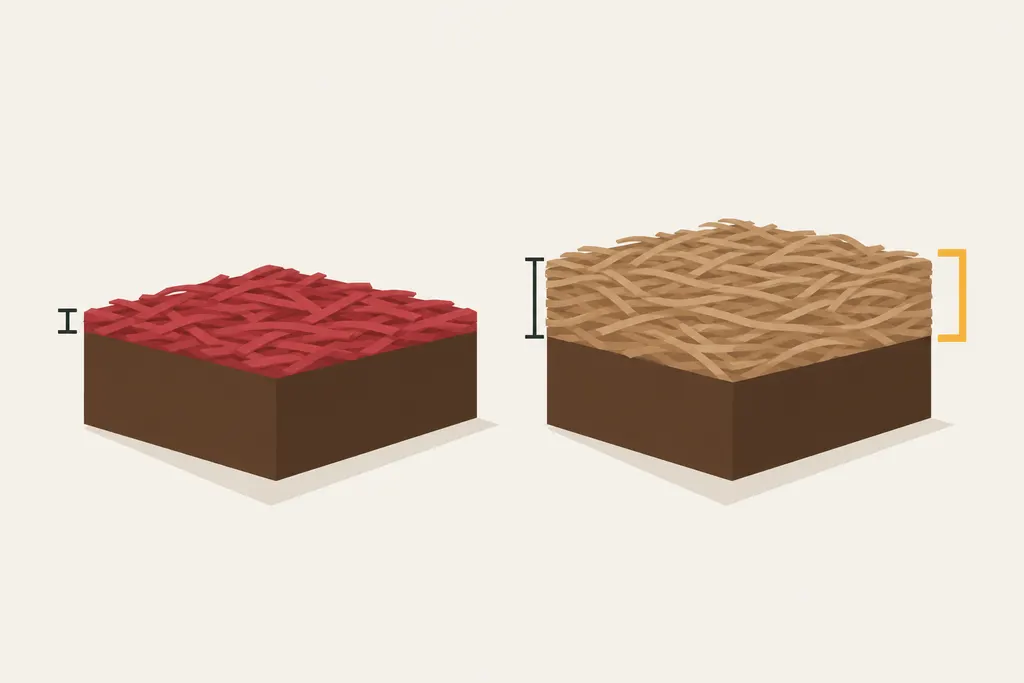
Rubber needs less depth. Wood costs less per yard. Which one comes out ahead depends on the area, so compare both for the same 400 sq ft play area.
CPSC lists shredded rubber at 6 in for a 10 ft fall height. For 400 sq ft that is 7.41 cubic yards. This Old House says rubber is not readily sold in bulk and lists bags at about $6. At 250 bags, that comes to about $1,500. Bulk and installed prices run $80–$160 a yard (Fixr) or $80–$140 installed (LawnStarter), which is $593–$1,185 for this area. CPSC asks that rubber products made for playgrounds be tested to ASTM F1292.
Wood chips need 9 in packed, so CPSC’s example starts with 12 in. For 400 sq ft, 12 in is 400 cu ft, or 14.81 cubic yards. This Old House puts playground mulch at $50–$60 a yard, so the material is $741–$889. CPSC warns against mulch from CCA-treated wood, and against mulch whose CCA content is unknown.
Engineered wood fiber is not in Table 2. CPSC says it should meet ASTM F2075 and be tested to ASTM F1292. The maker should supply the fill depth and the fall height it covers. LawnStarter lists wood fiber playground mulch at $65 a yard installed. If your product calls for 12 in, the 400 sq ft area takes 14.81 yards, about $963 installed.
Bags of rubber mulch per square foot
A 0.8 cu ft bag spread 1 in thick covers 9.6 sq ft. Toolbox Supply prints 9.6 sq ft of coverage on a Rubberific bag with a 15 lb shipping weight; it gives no depth, but that figure is what 1 in works out to. Deeper layers divide that coverage by the depth.
| Depth (in) | Sq ft per 0.8 cu ft bag | Bags per 100 sq ft | Cubic yards per 100 sq ft |
|---|---|---|---|
| 1 | 9.6 | 11 | 0.31 |
| 3 | 3.2 | 32 | 0.93 |
| 6 | 1.6 | 63 | 1.85 |
By weight, Gravel Shop’s 15–25 lb per cu ft equals 405–675 lb per cubic yard. The 15 lb bag works out to about 19 lb per cu ft, inside that range.
Cost per bag and per cubic yard
| Item | Price | Unit | Source |
|---|---|---|---|
| Rubber mulch, 0.8 cu ft bag | $6 | bag | This Old House |
| Rubber mulch, 0.8 cu ft bag | $13.99 | bag | Toolbox Supply (one store) |
| Rubber mulch | $80–$160 | cubic yard | Fixr |
| Rubber mulch, installed | $80–$140 | cubic yard | LawnStarter |
| Playground mulch (wood) | $50–$60 | cubic yard | This Old House |
| Wood fiber playground mulch, installed | $65 | cubic yard | LawnStarter |
A yard takes 34 bags of 0.8 cu ft. At $6 to $13.99 a bag, that is $204 to $476 per yard, well above the bulk figures. If a supplier near you sells rubber by the yard or the pallet, ask for that price before buying bags. This Old House found bulk rubber hard to come by.
Edging and drainage under a play area
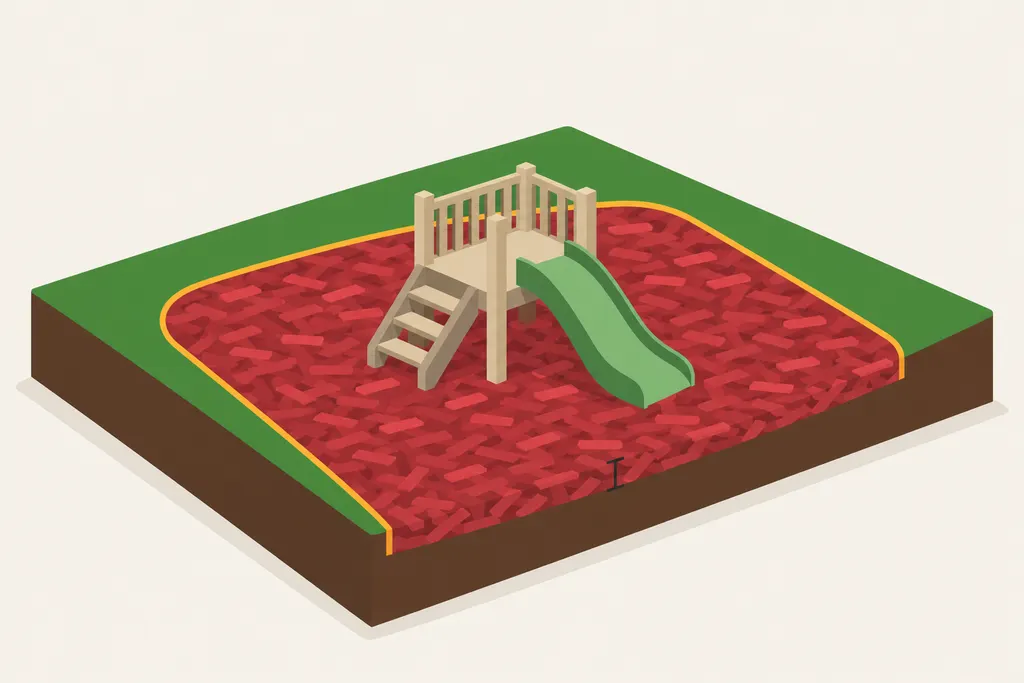
Loose fill moves. Kids kick it out from under swings and slide exits, and rain can wash it away. The CPSC handbook covers this in a few plain points.
- Plan a border around the whole use zone to hold the loose fill in
- Make the border easy to see, in a color that contrasts with the surfacing
- Check drainage: CPSC says standing water makes surfacing less effective and speeds compaction
- Never put loose fill straight on concrete or asphalt without the extra layers CPSC describes
- Mark the minimum fill level on equipment posts so low spots are easy to spot
- Check depth often under swings and at slide exits, where fill gets displaced most
- Call 811 before digging footings or a sunken play area
Over a hard surface, CPSC describes a gravel layer for drainage, then geotextile cloth, then loose fill at the Table 2 depth. It adds impact mats in high-traffic spots. Grass and bare dirt do not count as protective surfacing in the handbook.
Questions people ask
How many bags of rubber mulch do I need for a playground?
Multiply the use zone area by the depth in inches, divide by 12, then divide by 0.8. A 20 × 20 ft area at 6 in needs 250 bags. A 12 × 12 ft area needs 90.
How deep should rubber mulch be under a swing set?
CPSC Table 2 lists 6 in of shredded rubber for fall heights up to 10 ft. For swings, fall height is measured from the pivot point, where the chains hang from the top bar. The use zone runs twice that height to the front and back.
How much does rubber mulch weigh?
Gravel Shop gives 15–25 lb per cu ft, which is 405–675 lb per cubic yard. A 0.8 cu ft bag at one store weighs 15 lb. That is a fraction of what the same volume of stone weighs.
Is rubber mulch more expensive than wood mulch?
Per yard, yes: $80–$160 for rubber (Fixr) against $50–$60 for playground wood mulch (This Old House). Rubber needs less depth, though. For 400 sq ft, rubber bulk at 6 in runs $593–$1,185, and wood at a 12 in fill runs $741–$889.
Does rubber mulch pack down like wood?
Not in the same way. CPSC says most loose fill compresses at least 25% over time, with wood chips as its example, but a footnote to Table 2 says shredded rubber does not compress like other loose fill. It still gets displaced, especially under swings and at slide exits, so mark the 6 in level on the posts and top up low spots.
Some drawings on LandscapeFill were made with an AI image tool. They are simplified sketches of yards and materials, not photos of real projects, products, places or people.
Sources 6
Checked and updated November 22, 2026